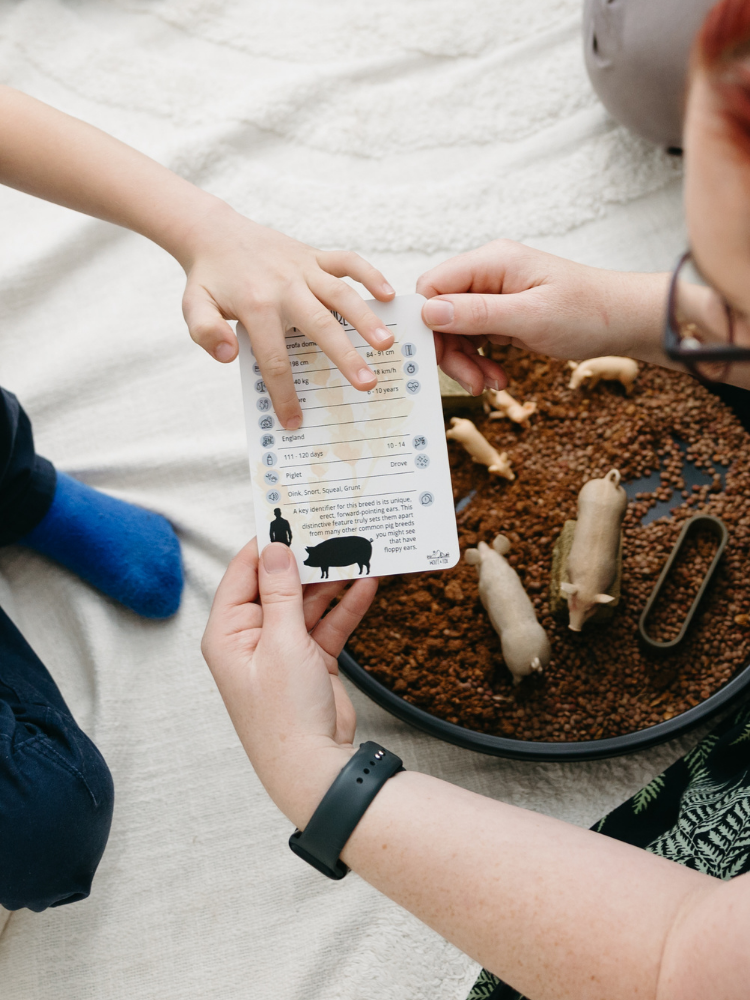


Your new animal card sets are more than just beautiful facts—they're a whole library of interactive fun! Whether you've got tiny Little Legends (ages 3–6), competitive Epic Explorers (ages 7–12), or a full house ready for The Whole Pack (family), there's a game to fit your needs.
We’ve broken down the best ways to play with each set, offering specific games tailored to every age group. Get ready to learn, laugh, and play!

🐓 Animal Sounds Match
-
Age Group: Little Legends (Ages 3–6)
-
Game Goal: To quickly match the auditory cue (animal sound) to the correct animal card.
-
How to Play:
-
Spread all the cards from the Farm Friends set face up on the playing surface. Remove any duplicate animals (i.e., remove all but one horse).
-
One player chooses a card from the display.
-
The player then makes the sound of the animal on the card (e.g., "Baa!" for the sheep).
-
The other players race to touch or point to the matching card.
-
-
Winning the Game: The first player to correctly identify and touch the card wins the round and keeps the card. The game ends when three cards are left. The player who has collected the most cards wins the game.
-
Variations:
-
Toddler Focus (Ages 3–4): Limit it to 10 or less cards.
-
Advanced Play (Ages 7+): Play with the cards face down, requiring players to name the animal before checking the picture. Alternatively, add in all the cards and the players have to choose which specific animal was chosen, even if multiple cards have the same noise.
-
🐐 Purpose Puzzle
-
Age Group: Epic Explorers (Ages 7–12)
-
Game Goal: To demonstrate knowledge of the animals' primary function on the farm using facts found on the back of the cards.
-
How to Play:
-
Shuffle the deck and place it face down.
-
Players take turns drawing the top card and keeping the picture side hidden from the other players.
-
The player must state the animal's purpose (e.g., "This animal's purpose is to produce wool and meat") and then reveal the card.
-
The first opponent to correctly guess the animal's name wins the card.
-
-
Winning the Game: The game ends when the deck is depleted. The player who has collected the most cards wins.
-
Variations:
-
Helpful Hints (Ages 3–6): The adult can provide the sound the animal makes as an extra hint.
-
Speed Challenge (Family): Use a 30-second timer. The guessing player must also state a numerical fact (like weight or height) from the card's back to confirm their guess.
-
👨👩👧👦 Barnyard Bingo
-
Age Group: The Whole Pack (Family)
-
Game Goal: To be the first player to match a full row, column, or diagonal of drawn animals on their Bingo card.
-
How to Play:
-
Each player receives a unique Bingo Card. Click here to download your Print & Play Bingo Cards!
-
Place all animal cards face down in a draw pile.
-
Establish the Rotation: The caller will cycle through three categories: Animal Name, Animal Sound, and Baby Name. The game starts with Animal Name.
-
A designated caller draws one card. The caller reads the information based on the current category (e.g., if on 'Animal Sound', they say "Moo!").
-
Players mark the corresponding animal on their Bingo card, identifying the animal based on the clue. The "SHIELD" space is a free space.
-
After the card is read, place it in a discard pile and advance the rotation to the next category (Sound, then Baby Name, then back to Name).
-
Continuous Play: If the draw pile runs out, shuffle the cards to create a new draw pile and continue the category rotation.
-
-
Winning the Game: The first player to mark five spaces in a row (horizontal, vertical, or diagonal) and correctly shout "BINGO!" wins the game.
-
Variations:
-
Advanced Challenge: Play "Blackout," where the entire Bingo card must be covered to win.
-
Go-To Game: 20 Questions
-
Game Goal: To use precise, deductive questioning to identify a hidden animal card in 20 questions or fewer.
-
How to Play:
-
One player or adult secretly selects a card from the Farm Friends set.
-
The other players take turns asking "yes" or "no" questions to narrow down the possibilities.
-
Players are encouraged to use the facts from the back of the cards in their questions (e.g., "Does it weigh more than 100 kg?").
-
-
Winning the Game: The players win if they correctly name the animal within 20 questions. The player who chose the card wins if the guessers fail.
-
Variations:
-
Little Legends (Ages 3–6): Only allow questions about colour, number of legs, or where it lives (barn or field).
-
Expert Level (Ages 12+): Instead of guessing what the animal is, they have to guess a specific fact about one of the animals.
-

🏡 Who's in the Barn?
-
Age Group: Little Legends (Ages 3–6)
-
Game Goal: To use deductive reasoning and strategic questioning to correctly identify a hidden animal card.
-
How to Play:
-
An adult (the "Barn Keeper") secretly hides a few animal cards in a small box (the "barn").
-
The child (the "Detective") asks simple "yes" or "no" questions about the animals they think are hidden.
-
The Barn Keeper answers truthfully based on the cards in the box.
-
The Detective can guess the animal at any time.
-
-
Winning the Game: The game ends when the Detective correctly names all the hidden animals. The Detective wins if they guess the animals before the question count reaches 10. The Barn Keeper wins if the Detective can't guess by the 10th question.
-
Variations:
-
Simpler Set (Ages 3–4): Hide only 2 cards to simplify the guessing pool.
-
Fact Detective (Ages 7+): The Barn Keeper can only answer based on facts found on the back of the card, forcing players to use detailed questions about weight, height, or habitat.
-
❓ Farm Feud
-
Age Group: Epic Explorers (Ages 7–12)
-
Game Goal: To test and improve knowledge of specific animal facts found on the cards by challenging opponents.
-
How to Play:
-
Shuffle the deck and divide the cards evenly among all players. Each player holds their cards so only they can see the facts on the back.
-
Players take turns asking an opponent a question based on a fact on a card they hold (e.g., "What is the scientific name of the Pekin Duck?").
-
If the opponent answers correctly, they win the card used for the question. If they answer incorrectly, the questioner keeps their card.
-
-
Winning the Game: The game ends when one player loses all their cards. The last player with cards remaining is the winner.
-
Variations:
-
Visual Aid (Ages 3–6): Focus the questions only around the simpler facts (e.g., What sound does a horse make?").
-
The Challenge (Family): Introduce a "Challenge" rule where if a player thinks the question is too easy or too hard, they can challenge the questioner to answer the question about a different card they hold.
-
🎭 Animal Charades
-
Age Group: The Whole Pack (Family)
-
Game Goal: Players act out the animal on their card while others try to guess what it is.
-
How to Play:
-
Divide players into two teams.
-
Shuffle the cards and place them face down.
-
A player from Team A draws a card and must act out the animal. Younger players can use actions and sounds, while older players can be challenged to act it out silently.
-
Team A has 60 seconds to guess the animal.
-
Play rotates to a player on Team B.
-
-
Winning the Game: The team that correctly guesses the animal before the timer runs out scores one point. The first team to reach a score of 10 wins the game.
-
Variations:
-
Sound Inclusion (Ages 3–6): Allow players to use the animal's sound while acting.
-
Function Focus (Ages 7+): Restrict acting to only the movement or behaviour associated with the animal's function (e.g., shearing for a sheep).
-
Go-To Game: Odd One Out
-
Game Goal: To use facts and observation to correctly identify which of three cards is the "odd one out" based on a chosen category.
-
How to Play:
-
An adult places three random cards face-up in the centre.
-
Players must decide which one is different and explain why, using the facts on the cards (e.g. “This one is an omnivore, the others are herbivores”).
-
There can be multiple correct answers, but the player must provide factual justification.
-
-
Winning the Game: The player whose reason is accepted by the group or the designated adult scores one point. The first player to reach five points wins.
-
Variations:
-
Visual Focus (Ages 3–6): Focus the reasoning purely on what they can see on the front of the card (e.g., "The zebra is the odd one out because it's the only one with stripes").
-
Fact Combo: The player must use two separate facts to justify their choice.
-

🐟 Big or Small?
-
Age Group: Little Legends (Ages 3–6)
-
Game Goal: To visually compare two animals based on size (height and weight).
-
How to Play:
-
Lay out two cards side-by-side.
-
An adult asks the child which animal is bigger or smaller, comparing their height and weight, using the visuals on the front of the card.
-
As players get older, introduce the facts on the back (e.g., "Which one weighs more?").
-
-
Winning the Game: This is a non-competitive game focused on learning. The round ends when the child correctly identifies the larger or smaller animal.
-
Variations:
-
Fact Integration (Ages 7+): Players must use the actual numerical fact (e.g., "The Blue Whale is heavier at 160,000 kg").
-
🔎 Aquatic Who Am I?
-
Age Group: Epic Explorers (Ages 7–12)
-
Game Goal: To be the first player to guess a hidden animal based on a sequence of facts, starting with the most obscure.
-
How to Play:
-
One player acts as the host and secretly chooses a card.
-
The host reads a series of facts from the back of the card, starting with the most obscure (e.g., Scientific Name, Genus) and getting progressively easier (e.g., Diet, Habitat).
-
The other players race to be the first to guess the animal's common name.
-
-
Winning the Game: The player who guesses correctly wins the card. The player with the most cards wins the game.
-
Variations:
-
Clue Limit: Limit the host to only five clues before the guessers can try to name the animal.
-
🌊 Aquatic Story Chain
-
Age Group: The Whole Pack (Family)
-
Game Goal: To collaboratively create a continuous, imaginative story incorporating the animals and their facts.
-
How to Play:
-
The first player draws a card and starts a story with a sentence incorporating that animal (e.g., "A leopard seal swam up to the surface...").
-
Each subsequent player draws a new card and adds a sentence to the story, weaving in their animal and one of its facts (e.g., "...when suddenly, a yellow boxfish swam past! This surprised the leopard seal because they live in the Indian or Pacific Ocean, not here!").
-
-
Winning the Game: This is a collaborative game designed for fun and creativity. The game ends when the deck is depleted and the story reaches a conclusion.
-
Variations:
-
Fact Check: If a player uses a fact incorrectly, the next player can challenge them, and if the fact is wrong, the player's next turn is skipped.
-
Go-To Game: Would You Rather?
-
Game Goal: To use the facts on the cards to create entertaining "would you rather" scenarios, sparking discussion and debate.
-
How to Play:
-
A player draws two cards and uses the facts to create a "would you rather" question (e.g., "Would you rather have the length of a blue whale or have the maximum speed of an American lobster?").
-
Other players must choose one option and explain their reasoning using the facts on the card backs.
-
-
Winning the Game: This is a non-competitive game. The player who creates the most inventive scenario wins the round.

🐚 Where in the Water?
-
Age Group: Little Legends (Ages 3–6)
-
Game Goal: To correctly match the animal card to its general habitat or origin.
-
How to Play:
-
Spread the cards face-up. An adult or older sibling names a type of water body or habitat (e.g., “ocean,” or “wetland”).
-
The child then finds a card that matches that habitat (and confirms with the facts on the back).
-
-
Winning the Game: This is a non-competitive game. The round ends when the child correctly identifies the card.
🛡️ Conservation Captains
-
Age Group: Epic Explorers (Ages 7–12)
-
Game Goal: To use the conservation icons to debate which animals are in the most trouble, using facts from the card to support their argument.
-
How to Play:
-
Each player is dealt five cards.
-
Each player acts as a "Conservation Captain" and chooses one animal to argue for, using the conservation icons and the facts on their card to argue why their animal needs the most help.
-
The group votes on the most persuasive argument.
-
-
Winning the Game: The player whose argument wins the vote keeps their card. The player with the most cards at the end of the game wins.
-
Variations:
-
The Challenge: Introduce a "Challenge" rule where an opponent can use a fact from their own card to try and disprove an opponent's argument.
-
📈 Aquatic Stat Showdown
-
Age Group: The Whole Pack (Family)
-
Game Goal: To win an opponent's card by having the superior numerical fact in a chosen category.
-
How to Play:
-
Players each get an equal stack of cards, held face down.
-
The first player calls a category (e.g. “fastest,” "heaviest," or "longest").
-
All players reveal their top card simultaneously and read the value for that category.
-
The player with the highest value wins the round and collects all the cards.
-
-
Winning the Game: The game ends when one player has collected all the cards.
-
Variations:
-
Lowest Wins: Agree before the round begins that the lowest value wins (e.g., shortest length or lowest weight).
-
Go-To Game: Drawing Duel
-
Game Goal: To use drawing to communicate the name of the animal on a card without speaking.
-
How to Play:
-
A player draws a card and must draw the animal on their card without speaking.
-
The other players race to guess the correct animal name.
-
The player may not use writing or draw mimes that resemble letters.
-
-
Winning the Game: The player who guesses correctly wins the card. The player with the most cards wins the game.
-
Variations:
-
Fact Drawing (Ages 7+): The drawing player must visually incorporate one key fact from the back of the card (e.g., drawing the animal's main prey item).
-

🏡 Wild Homes
-
Age Group: Little Legends (Ages 3–6)
-
Game Goal: To match the animal card to its general habitat or origin.
-
How to Play:
-
Spread the cards face-up. An adult names a habitat or origin from a card (e.g. “Find an animal from the grasslands” or "Find an animal from Africa").
-
The child then finds a card that matches the description.
-
-
Winning the Game: The player who collects the most cards by the end of the game wins.
🦁 Wild Kingdom Food Chain
-
Age Group: Epic Explorers (Ages 7–12)
-
Game Goal: To deal a knockout blow by successfully linking animals according to their diets to build a continuous food chain.
-
How to Play:
-
Deal all the cards equally among the players.
-
Individually, try to create the longest food chain with the cards in your hand.
-
The player with the longest chain wins. In case of a draw, whoever's animal is the fastest animal (of the last played card) wins.
-
-
Winning the Game: The player who has the longest chain wins. The first player to win five rounds wins the game.
-
Variations:
-
Fact Check: Rather than playing individually, rotate around the circle and place one card. If a player cannot play a card, they are out of that round. The last player standing wins.
-
🏆 The Ultimate Animal
-
Age Group: The Whole Pack (Family)
-
Game Goal: Each player secretly picks a card and argues why their animal is the "ultimate" in a given category using its stats and fun facts.
-
How to Play:
-
Each player secretly picks a card and keeps it hidden.
-
The first player calls out a challenge category (e.g., "Speed," or "Diet").
-
Each player takes a turn arguing why their animal is the "Ultimate" in that category, using facts from the back of the card to support their arguments.
-
The family then votes on a winner for the round.
-
-
Winning the Game: The player who wins the vote keeps their card. The player with the most cards wins the game.
-
Variations:
-
Hidden Identity: Players must argue without revealing the animal's name until the end of the round.
-
Go-To Game: Two Truths, One Lie
-
Game Goal: A player chooses a card and makes three statements about it—two true and one false. The others try to guess the lie.
-
How to Play:
-
A player secretly chooses a card and looks at the facts on the back.
-
They state three "facts" about the animal: two true ones and one lie (e.g., "It's a carnivore," "It can run up to 45 km/h," "It is taller than a person").
-
The opponent must correctly identify the lie.
-
-
Winning the Game: If the opponent correctly identifies the lie, they win the card. If they fail, the original player keeps the card. The game ends when one player reaches 10 cards.
-
Variations:
-
Fact Limit: The lie must be based on a fact category that is clearly listed on the back of the card, not an outside fact.
-

🧠 Fact Finders
-
Age Group: Little Legends (Ages 3–6)
-
Game Goal: To match a short, simple fact to the correct animal card.
-
How to Play:
-
Spread all cards face-up. An adult reads a simple, short, fun fact from one of the card's beautiful images without saying the animal’s name (e.g., "This animal looks so cuddly").
-
The child then finds the card that the fact belongs to.
-
-
Winning the Game: This is a non-competitive game. The round ends when the child correctly identifies the card.
🧮 Trait Tally
-
Age Group: Epic Explorers (Ages 7–12)
-
Game Goal: To quickly tally the number of cards in their hand that share a specific fact (trait).
-
How to Play:
-
Deal the cards equally among players, who keep their cards hidden.
-
One player calls out a trait (e.g. “carnivore,” “mammal,” or “lives in North America”).
-
Everyone quickly counts their hidden cards with that trait.
-
The player with the highest tally wins the round and collects one card from the player with the lowest tally.
-
-
Winning the Game: The player who collects the most cards wins the game.
-
Variations:
-
Trait Challenge: Players must try to guess which opponent had the highest tally before they reveal their number.
-
🛡️ Survival of the Pack
-
Age Group: The Whole Pack (Family)
-
Game Goal: The family works together to "survive" a scenario, using the facts on the cards to explain how their animal would contribute.
-
How to Play:
-
Players each secretly choose a card.
-
The designated leader announces a survival scenario (e.g., “A flash flood is approaching!” or "We need to find enough food for winter.").
-
Players use their cards to explain how their animal would contribute to the pack’s survival based on its speed, diet, or other traits.
-
The group then determines if the "pack" survives the challenge.
-
-
Scenario Examples:
-
Disaster: "A sudden, deep snowfall has covered all the low-lying food sources. How does our pack get sustenance?"
-
Predator: "A rival pack has challenged our territory. Which animal is best suited to stand guard or scare off the intruder?"
-
Journey: "We must cross a wide, fast-flowing river to reach a new watering hole. How do we get everyone across safely?"
-
Shelter: "A fierce thunderstorm is coming. We have 60 seconds to find or build the best shelter. Which animal is the key to our protection?"
-
-
Winning the Game: This is a collaborative game. You win if you "survive".
-
Variations:
-
Limited Facts: Restrict players to only using a small number of facts from chosen categories for the round.
-
Go-To Game: Fact Scramble
-
Game Goal: To be the first to unscramble a set of keywords from a fun fact and guess the correct animal.
-
How to Play:
-
A player reads the fun fact from a card but only says the key words out loud in scrambled order (e.g., for "The brown bear digs dens to hibernate," they might say: "DEN, DIGS, HIBERNATE").
-
The others must unscramble the fact and guess the animal.
-
-
Winning the Game: The first player to correctly unscramble the fact and guess the animal wins the card. The player with the most cards wins.
-
Variations:
-
Sentence Construction: The player who guesses correctly must also put the unscrambled words back into a grammatically correct sentence about the animal.
-

🗣️ Prehistoric Pronunciation Match
-
Age Group: Little Legends (Ages 3–6)
-
Game Goal: To match the pronunciation of the complex dinosaur name to the correct card.
-
How to Play:
-
Lay out a few cards face up. While the child’s eyes are closed, an adult reads a pronunciation (e.g. “BRAK-ee-oh-SORE-us”) and mixes the cards.
-
The child then tries to match the name they heard to the correct card.
-
-
Winning the Game: This is a non-competitive game. The round ends when the child correctly identifies the card.
-
Variations:
-
Sound Clue: The adult can read the pronunciation again after the cards are mixed for an easier match.
-
🗓️ Dino Timeline
-
Age Group: Epic Explorers (Ages 7–12)
-
Game Goal: To arrange a series of cards in chronological order based on the "Time Period" fact.
-
How to Play:
-
Deal the cards out evenly to all players.
-
Players then arrange them in chronological order based on the Time Period fact or Era icon (e.g., 157–145 MYA).
-
The first player to correctly order their cards from earliest to most recent wins.
-
-
Winning the Game: The first player to correctly order their cards wins the round. The first player to win five rounds wins the game.
-
Variations:
-
Timeline Challenge (Cooperative): Rather than competing, players work together to put the entire deck in chronological order.
-
📜 Code Breaker
-
Age Group: The Whole Pack (Family)
-
Game Goal: To be the fastest to guess the dinosaur by reading the meaning of its name (on the back of the card).
-
How to Play:
-
Deal all the cards equally among the players, who hold them face down.
-
A player draws a card and reads the Meaning of Name fact from the back (e.g. “This animal’s name means ‘arm lizard’”).
-
The first player to guess the correct common name (Brachiosaurus) wins the card.
-
-
Winning the Game: The player with the most cards at the end of the game wins.
-
Variations:
-
Fact Clues: The player can provide one extra clue (e.g., the Time Period) if no one guesses correctly after 30 seconds.
-
Go-To Game: Journey Around the World
-
Game Goal: To collaboratively create a story about an animal’s journey from one place to another using the facts on the cards.
-
How to Play:
-
The first player draws a card and establishes the animal and its Origin (using the Origin or Habitat fact).
-
The next player draws a card and must continue the story, detailing how the animal's traits (speed, size, diet) would help it journey to the new animal's Origin or a different Habitat.
-
Players must reference the Origin and Habitat facts on their cards to drive the narrative.
-
-
Winning the Game: This is a collaborative game designed for imaginative fun. The game ends when the deck is depleted or the story reaches a satisfying conclusion.
-
Variations:
-
Fact Challenge: Players must also state the exact coordinate or time period on the card to prove the animal's location.
-

✍️ Missing Dino
-
Age Group: Little Legends (Ages 3–6)
-
Game Goal: To use visual memory to correctly identify which card has been removed from a small group.
-
How to Play:
-
Lay 4 to 6 cards face up on the table.
-
Let the child study them for a brief period.
-
Ask the child to close their eyes.
-
Remove one card, mix up the remaining cards, and ask the child to open their eyes.
-
-
Winning the Game: The round ends when the child correctly names the missing card. The child wins the round and keeps the card.
-
Variations:
-
Fact Recall (Ages 7+): After naming the missing card, the child must state one fact about that animal from memory.
-
🔗 Fossil Links
-
Age Group: Epic Explorers (Ages 7–12)
-
Game Goal: To be the first player to run out of cards by forming a chain based on a shared trait.
-
How to Play:
-
Deal all cards evenly among players, who keep their cards visible.
-
The first player plays any card. The next player must play a card that shares a specified trait (e.g., both are herbivores, both are from the Jurassic Era) with the previously played card.
-
If a player cannot play a card, they draw one from a discard pile (if playing with two decks) or lose a turn.
-
-
Winning the Game: The first player to run out of cards wins.
-
Variations:
-
Trait Change: When a player plays a card, they can announce a new trait that the next player must match.
-
📏 Size Up
-
Age Group: The Whole Pack (Family)
-
Game Goal: Work together to create a visual "parade" of cards, arranging them in order of size.
-
How to Play:
-
Players cooperatively draw cards and arrange them on the table in order of a chosen metric (e.g., shortest to longest, or lightest to heaviest).
-
Players may use the facts on the back to check their arrangement.
-
-
Winning the Game: This is a collaborative game. You win when all cards have been placed in the correct sequential order.
-
Variations:
-
Story Time: Once the parade is correctly arranged, take turns telling a story about what happens as the largest animal tries to fit past the smallest one.
-
Go-To Game: Bluffing Beasts
-
Game Goal: To successfully bluff opponents or correctly call their bluff regarding the facts on their hidden cards.
-
How to Play:
-
Each player draws a card but keeps the facts hidden from others.
-
Players take turns making a statement about their animal’s stats (e.g., “My animal weighs over 500 kg” or "My animal has a longer neck than yours").
-
Other players decide whether to "believe" the statement or "call their bluff."
-
If a player "calls the bluff," the card is revealed. If the statement was false, the bluffer loses the round. If the statement was true, the caller loses the round.
-
-
Winning the Game: The game ends after five rounds. The player with the most cards at the end wins.
-
Variations:
-
Fact Limit: Statements must reference a numerical value listed on the card (e.g., weight, height, speed).
-
With dozens of ways to play across all your card sets, your animal collection is truly a dynamic learning tool disguised as family fun. Whether you’re teaching a Little Legend their animal sounds or challenging an Epic Explorer on the scientific name of a prehistoric beast, these games offer real-time, interactive learning. So grab a stack, pick a game, and start your next great adventure—the whole animal kingdom awaits!